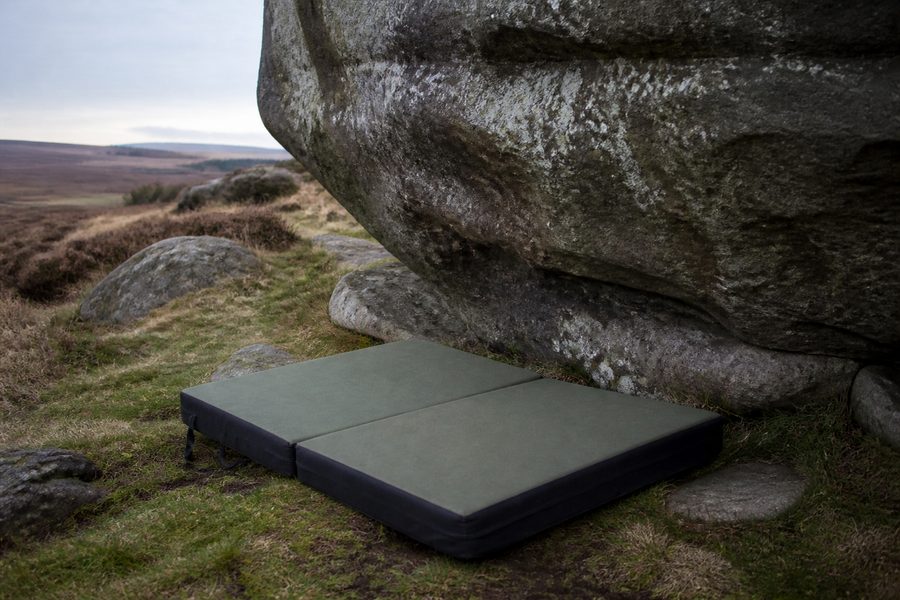
Short answer: choose for the landing, approach and pads your partners already carry. Our currently verified affiliate pick is the Ocún Dominator FTS, a deep pad with published UIAA 161 status. It is not automatically right for every fall: a broader or lighter setup may suit your local problems better.
| Verified affiliate pick | Open coverage | Thickness | Weight | Best use |
|---|---|---|---|---|
| Ocún Dominator FTS | 100 × 132 cm or 200 × 66 cm | 14.5 cm | 5.7 kg | Deeper padding and highball-focused use |
Dimensions and weight are manufacturer figures checked in August 2026. Recheck specifications and availability before purchasing.
Links: Browse available bouldering crash pads on Amazon UK (paid link)
First: what a crash pad can and cannot do
A crash pad attenuates impact; it does not remove the risk of injury. The UIAA 161 standard defines impact attenuation and a critical fall-height test, but many pads on the market do not carry the UIAA Safety Label. Absence of a label is not proof that a pad is poor, and possession of a labelled pad is not permission to ignore the landing.
The BMC’s outdoor-bouldering guidance recommends padding landings carefully, thinking through the likely fall, climbing with attentive partners and learning how to fall and land. Those behaviours matter as much as the badge on the foam.
How much coverage do you need?
Start with the fall zone, not the height of the boulder. A straight lowball over flat ground may be straightforward to pad. A lower problem with a sloping landing, protruding block or sideways swing can require several pads and an attentive person to move them.
- One regular pad: reasonable for selected low problems with compact, flat landings and predictable falls.
- Two regular pads: create more coverage and let you overlap hinges or protect a likely sideways fall.
- Large pad plus regular pad: useful where the fall zone is broad but one hazard needs extra depth.
- Slider or sit-start pad: covers seams, low rocks or a sit start; it is not a substitute for a full pad.
If the landing needs three pads and you have one, the correct consumer advice is not “buy the thickest pad”; it is to choose another problem or return with partners and appropriate equipment.
Ocún Dominator FTS — affiliate pick for depth and published certification
Ocún’s 2027 technical workbook lists the Dominator FTS at 14.5 cm thick and 5.7 kg, with a 100 × 132 cm conventional layout or a long 200 × 66 cm layout. Its foam-tube-suspension block sits between PE foam layers, and the product is listed in the UIAA database under UIAA 161 with an active label at the time checked.
This is the option to investigate when foam depth and certified impact testing are priorities. The long configuration can also be useful beneath a traverse or linear landing. It is not automatically the best pad for every fall: a thick pad in the wrong place still leaves the hazard exposed.
Buy it if
- You want a deep foam system with published UIAA 161 status.
- The two-direction layout suits your landings.
- You accept a 5.7 kg carrying weight.
Avoid it if
- Your approaches strongly favour a lighter setup.
- You mainly need a large square area rather than extra depth.
Links: Check Amazon UK (paid link) · Manufacturer specifications
Hinge, taco and hybrid: the honest trade-off
A hinge pad folds flat and packs neatly. On flat ground, two hinge pads can join cleanly. The hinge itself can become a weak line if it sits over a pointed rock or an uneven depression, so placement matters. A taco pad bends continuously and can wrap irregular ground, but it stores bulkier and may resist lying completely flat. Hybrid designs attempt to reduce hinge problems while retaining a compact fold.
There is no defensible rule that “hinge always wins on grit.” Inspect the landing and make the fold work for the terrain. Never place an open hinge directly over a protruding hazard without filling or bridging it appropriately.
How to place pads better
- Work out the most likely fall direction before the climber leaves the ground.
- Cover rocks, slope transitions and the edge of the main pad—not just the spot directly below the final hold.
- Overlap or close seams so a foot cannot punch between pads.
- Put shoulder straps and buckles face down or away from the landing surface.
- Use a spotter to guide the climber toward the pads, not to catch their full weight.
- Reposition after every fall if the pads have moved.
- Pick pads up rather than dragging them across vegetation or fragile ground.
When to replace the foam
Foam softens with repeated impacts, age and storage. Warning signs include permanent compressed areas, bottoming out on routine falls, separated layers, a cover that no longer holds the foam in position or damage that exposes the interior. Follow the manufacturer’s inspection and replacement guidance. Replacement foam is preferable where the maker supports it; improvised household foam changes the system and should not be assumed equivalent.
Our verdict
The Dominator is the only named pad we currently recommend because we have verified an exact commission-earning Amazon listing for it. Consider it when depth and UIAA-labelled testing are priorities. Do not force the choice when your approach, landing shape or carrying limit calls for a different setup.
Use the pad with venue knowledge: read our The Roaches guide, Stanage Edge guide and beginner Stanage planning guide before travelling.
Frequently asked questions
Is one crash pad enough?
Only for selected problems with a compact, predictable and relatively level landing. Many outdoor problems need more coverage or a different choice of problem. Never let the number of pads pressure you into climbing something unsuitable.
Does a thicker pad always protect better?
No. Foam formulation, layer construction, age, impact location and placement all matter. Thickness is useful information, not a complete performance score.
Can I buy a crash pad second-hand?
You cannot easily verify its impact history or internal foam condition. The UIAA advises caution with used safety equipment because integrity can be difficult to guarantee. If considering one, inspect it closely and ask the manufacturer whether replacement foam is available.
Can I use a folding gym mat?
Do not assume a household or exercise mat attenuates impact like a purpose-built bouldering pad. Construction, foam behaviour, cover retention and portability are different.
Specification and safety sources
Product figures were checked against Ocún’s current Dominator technical information. Safety context comes from the UIAA 161 crash-pad standard, the UIAA certified-equipment database and the BMC outdoor-bouldering guide.
Affiliate disclosure: Amazon links are paid links. As an Amazon Associate I earn from qualifying purchases. Manufacturer links above are specification sources, not retailer recommendations.